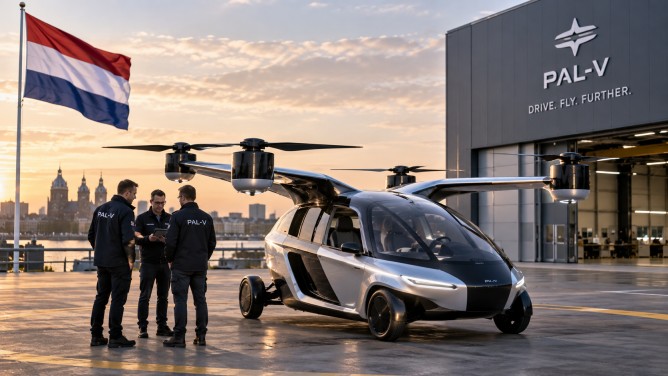
PAL-V, a Dutch company, has moved closer to launching its Liberty flying car commercially, having received approval from the European Union Aviation Safety Agency (EASA) to start manufacturing aviation components. This approval is a significant milestone as it permits the production of the aircraft-related parts for the Liberty model. The next crucial step for PAL-V is to secure full certification for the vehicle as an aircraft, a process the company anticipates completing by 2028.
The Liberty is an innovative vehicle that merges the functionality of a road car with the capabilities of an aircraft. It features a retractable rotor and propeller system that allows it to fly. However, unlike helicopters, the Liberty cannot perform vertical takeoffs and landings; instead, it requires a runway to become airborne and to land. On the ground, it operates just like a conventional car, reaching speeds of up to 160 km/h.
To operate the Liberty, both a driving license and a pilot’s license are necessary due to its dual nature. The vehicle boasts a flying range of approximately 500 kilometers, making it a versatile option for a variety of uses. Despite its futuristic appeal, the Liberty comes with a starting price tag of around €299,000, excluding taxes and additional costs.
Interest in the Liberty is already strong, with PAL-V reporting that the initial production batch of 250 units has been sold. Among the early adopters is the Dutch fire brigade, illustrating the vehicle’s potential utility in emergency and service sectors. The company is optimistic that with final aviation certification, the Liberty flying cars will be operational by 2028, marking a new era in personal and specialized transportation.