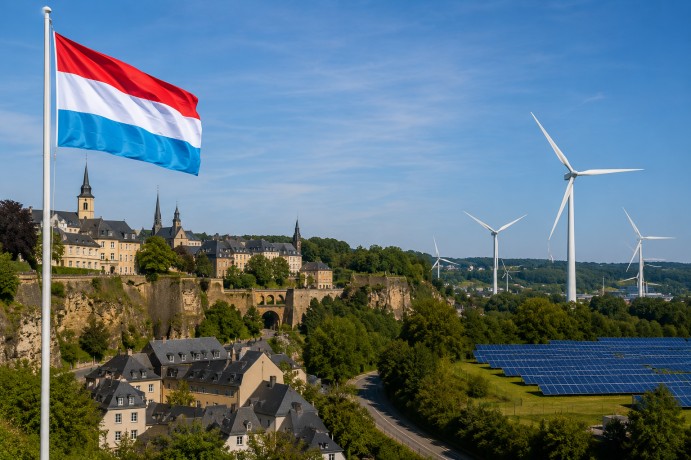
In 2025, Luxembourg found itself near the bottom of the list for renewable electricity consumption among European Union member states, as detailed in the most recent Eurostat report. Despite a general increase in the adoption of renewable energy across the EU, Luxembourg’s reliance on these sources for its gross final energy consumption stood at just 20.2%, which was among the lowest within the union. The country managed to produce only 23.3% of its gross electricity consumption from renewable sources, surpassing only Czechia and Malta in this regard.
The broader European Union, meanwhile, achieved a notable milestone, with renewables making up 26.2% of its gross final energy consumption in 2025. This figure marks significant progress from 2004, when renewable energy accounted for just 9.6% of the EU’s energy consumption. The EU has set an ambitious target to further increase this share to 42.5% by the end of the decade in 2030, highlighting its commitment to transitioning towards more sustainable energy solutions.
Leading the charge in renewable energy within the EU, Sweden emerged as the top performer, with 65.4% of its total energy consumption deriving from renewable sources. Following Sweden, Finland and Denmark also showed impressive figures, underscoring their strong commitment to renewable energy adoption. In the realm of electricity specifically, Austria distinguished itself by generating more than 90% of its electricity from renewables, securing its position as the leader in this category.
While Luxembourg’s performance in renewable energy consumption remains modest, its position can be understood within the context of the broader EU landscape, where countries are making strides at varying paces. The collective progress of the EU signals a strong regional push towards cleaner energy, with certain nations setting benchmarks that others aim to meet. As the EU works towards its 2030 goals, Luxembourg and other lower-ranking countries may need to accelerate their renewable energy initiatives to keep pace with the union’s overall objectives.